Sterilisation and Infection Control at Apollo Dental Vadavalli
Before any instrument touches your mouth at our Vadavalli clinic, it has already been through seven recorded steps. You can watch the last one happen. Every instrument arrives at the chair inside a sealed pouch, and that pouch is opened in front of you rather than somewhere out of sight.
This page sets out how we clean, sterilise and store our instruments, how we keep the rest of the treatment room controlled, and how we check that each cycle actually worked. Read it before your first visit, and ask us about any part of it when you are here.
What makes a dental clinic safe, and what you can check yourself
Most patients are told that a clinic is hygienic. Very few are shown how. Infection control is one of the few things in dentistry you can assess with your own eyes, in the first two minutes of an appointment, without any clinical training.
Here is what is worth looking for in any dental clinic in Coimbatore, including ours.
If a clinic cannot answer those questions, that is information too. We would rather you asked us than assumed.
- The instruments come to the chair sealed in a pouch, and the pouch is opened in front of you. Instruments lying loose on an open tray have no record of when they were last processed.
- Gloves and a mask go on after the dentist has washed or sanitised hands in the room, and both come off and are replaced for the next patient.
- The drill head, called the handpiece, is changed between patients rather than wiped with a cloth. This is the single most commonly cut corner in dentistry.
- Chair controls, the light handle and the X-ray sensor are either covered with a fresh barrier or wiped down while you watch.
- The clinic is willing to show you where sterilisation happens. A team that runs a documented protocol is usually happy to walk you through it.
Our seven step sterilisation protocol
Every reusable instrument we own follows the same seven steps, in the same order, every time. Nothing skips a stage because the day is busy. Each stage is recorded by the team member who carried it out.
-
1Collection
The used instruments are taken straight from the chair and placed into a covered tray of cleaning solution. They are never left out to dry.
Why it matters. Dried blood and debris are far harder to remove later, and anything still stuck to an instrument can shield organisms from steam. -
2Cleaning
The instruments go into an ultrasonic cleaner, which uses sound waves in liquid to lift debris out of hinges, grooves and serrations. Anything the machine cannot reach is scrubbed by hand with a long handled brush.
Why it matters. Sterilisation only works on a surface that is already clean. This step does more for your safety than any other. -
3Rinse, dry and inspect
Each instrument is rinsed, dried and checked under light. Anything blunt, pitted or damaged is taken out of use.
Why it matters. A damaged instrument holds debris and does not perform properly in the mouth. -
4Pouching
Instruments are sealed into individual pouches. A chemical strip on or inside each pouch will change colour only if the cycle conditions were reached.
Why it matters. Pouching is what lets an instrument stay sterile after the machine, and what lets you see it opened at the chair. -
5The autoclave cycle
The sealed pouches are processed in a Class B autoclave, which removes air from the chamber before forcing in steam under pressure at a set temperature and holding it there for a set time.
Why it matters. Class B is the cycle type built for pouched instruments and instruments with narrow internal channels, such as the handpiece. Simpler cycles cannot reliably push steam into those spaces. -
6Cycle check and log
The cycle reading of time, temperature and pressure is checked and written into our sterilisation log, and the colour change on the pouch is confirmed before anything is stored.
Why it matters. If a cycle fails, the entire load goes back rather than into storage. The log is what makes that checkable afterwards. -
7Sealed storage
Pouches are stored sealed in a covered ultraviolet storage chamber, away from the treatment area, and taken out only at your chair.
Why it matters. Storage is where sterile instruments are most often compromised, usually by being kept loose in an open drawer.
National infection control guidance in India and international dental guidance agree on the core of this sequence. Instruments are cleaned before they are sterilised, packaged before heat sterilisation, and stored covered and closed until use.
What we sterilise, and what we throw away after one use
Not everything is meant to be reused. A good protocol is as much about what leaves the room as what goes back into the autoclave.
Needles, anaesthetic cartridges, surgical blades, gloves, masks, suction tips, saliva ejectors, cotton rolls, gauze, patient bibs, the protective barriers on the chair and light, and the polishing cups used during a cleaning.
Mirrors, probes, tweezers, scaling tips, extraction forceps, elevators, filling instruments, impression trays, and the handpiece and its attachments.
Instruments that go through gum or bone, such as those we use during an extraction or during implant surgery, are handled at the strictest level in the protocol and are always heat sterilised, never wiped down or chemically disinfected as a shortcut.
Infection control beyond the instruments
Instruments are the part patients notice. The room around them carries just as much of the risk, so it follows its own routine between every appointment.
Hands and protective wear
Hands are washed or sanitised before gloving and again after gloves come off. Gloves, mask and eye protection are changed for every patient. If a clinician has to leave the chair mid procedure, the gloves come off and a fresh pair goes on when they return.
Surfaces and equipment
Chair controls, the operating light handle, the headrest, the tray table, the intra oral camera body and the digital X ray sensor are either covered with a fresh disposable barrier for each patient or disinfected between appointments. The sensor that goes into your mouth is sleeved every time.
Water and suction lines
Suction lines and the spittoon are flushed between patients and cleaned at the end of each day. Water lines to the chair are flushed at the start of the day and between appointments, because water that sits still in a narrow line is its own problem.
Waste
Sharps go straight into a puncture proof container at the chair, never into a bin. Clinical waste is segregated into colour coded bags on site and handed to an authorised biomedical waste handler, as required of every clinic in Tamil Nadu. Nothing clinical leaves this building with the general rubbish.
How the room is laid out
Our sterilisation area runs in one direction, from the dirty end where used instruments arrive to the clean end where sealed pouches are stored. Processed instruments never travel back across an area where used ones are handled.
How we check the protocol is actually working
A protocol that is never tested is a claim, not a standard. Three separate checks run on our sterilisation, each catching a different kind of failure.
If any of the three fails, that load is reprocessed and the machine is taken out of use until it passes. The logs are kept at the clinic and you are welcome to ask to see them.
What infection control can and cannot promise
We will not tell you that anything here is one hundred percent anything. No clinic anywhere can honestly say that, and a clinic that does is telling you something about its marketing rather than its protocol.
What a documented protocol does is reduce the risk of anything passing from one patient to another to as low as current clinical standards allow, and make that reduction checkable rather than a matter of trust. That is a smaller claim than the ones you will read elsewhere, and it is one we can actually stand behind.
Two honest limits are worth stating. Sterilisation protects you from what other patients bring into the room. It does nothing about an infection already inside your own tooth or gum, which is what treatment is for. And we can only plan your treatment properly when we know your medical history, so tell us about any condition, medication or allergy before we start, including anything you think is unrelated.
Why this matters at our Vadavalli clinic
Marudhamalai Road has no shortage of dental clinics, and almost all of them will tell you they maintain hygiene. Very few will show you a protocol, name the machine, or hand you a log to look at. That gap is the reason this page exists.
The equipment we run this on is named, not implied. A Class B autoclave and an ultraviolet storage chamber for instruments. Sealed pouches opened at the chair. Digital imaging and a chairside intra oral camera, both sleeved or barriered for every patient, so you see your own tooth on screen without the equipment becoming a shared surface.
The protocol also does not change depending on who treats you or which day you come. We are open all seven days, and every clinician working here has more than five years of experience in their area of practice. The same seven steps run on a Sunday evening as on a Tuesday morning.
The same standard applies whether you are in for a routine teeth cleaning and scaling, a root canal treatment, or dental implants. You can read more about the technology and equipment we use, or about how this branch is run.
Book a visit, or come and look first
If you would like to see the sterilisation area before you book anything, you are welcome to walk in and ask. We will show you the autoclave, the storage chamber and the log, and you can decide from there.
Frequently asked questions about sterilisation at our clinic
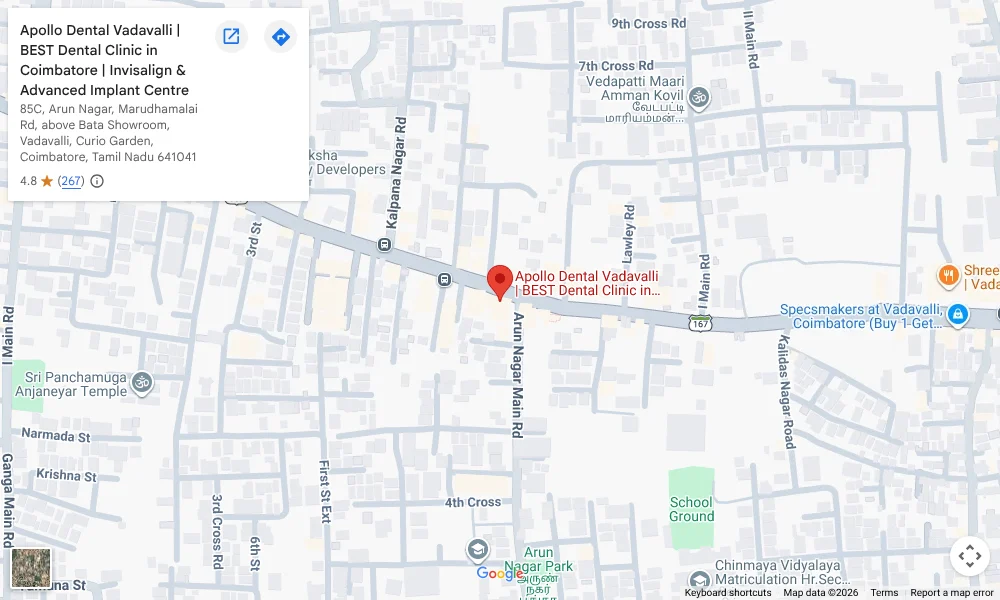
Find us on Marudhamalai Road
85C, Arun Nagar, Marudhamalai Road, above Bata Showroom, Vadavalli, Coimbatore, Tamil Nadu 641041. Look for the Bata Showroom — we are directly above it.