

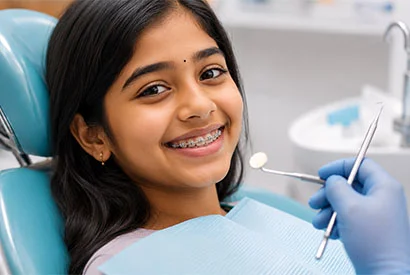
Your child’s new front teeth are coming in crooked, or sticking out, or there is a gap you did not expect, and you are wondering whether to do something now or wait. The what age to get braces question has a two-part answer. Most children start braces between 11 and 14, once most of the adult teeth are through. But the right age for a first orthodontic check is much earlier, around 7, because a few problems are far easier to fix while the jaw is still growing.
That does not mean a 7 year old needs braces. In most cases the dentist looks, reassures you, and asks you to come back in a year or two. In a smaller number of cases, a short course of early treatment prevents a much bigger job later.
This guide explains what the age 7 check looks for, which signs mean early treatment helps, what happens if you wait, and how to decide between braces and clear aligners for a teenager.
Is there a single right age for braces?
No, and any clinic that gives you one number without looking at your child is guessing. Braces move teeth, so they work once the teeth that need moving are in the mouth. For most children the last milk teeth fall out and the adult premolars and canines come through between 10 and 13, which is why the usual starting age for full braces is 11 to 14. The NHS in the UK puts the typical start at around 12 to 13 for the same reason (NHS).
Starting in this window has a second advantage. The jaws are still growing, and an orthodontist can use that growth to correct a bite where the upper and lower jaws do not match. After growth finishes, in the mid to late teens, the same correction may need extractions or, in severe cases, jaw surgery.
There is a lot of variation. Some children have all their adult teeth by 10; others are still losing milk teeth at 13. Girls tend to be a year or so ahead of boys. Your child’s dental age, judged from an OPG (a panoramic X-ray of all the teeth and both jaws), matters more than the birthday.
Adults can have braces at any age, provided the gums and bone are healthy, so missing the teenage window is not the end of the road. It simply means the treatment works with the jaw as it is rather than shaping it as it grows. The dental braces page explains the options at each age.
Why do orthodontists suggest a check at age 7?
The American Association of Orthodontists recommends that every child has a first orthodontic check by age 7 (AAO). By this age the first adult molars are in, the adult front teeth are coming through, and the dentist can see how the upper and lower jaws are lining up while there is still plenty of growth to work with.
The check itself is simple. The dentist looks at how the teeth meet, how the jaw moves, whether the child breathes through the mouth, and whether there are habits such as thumb sucking. If anything looks uncertain, an OPG shows which adult teeth are present under the gum, whether any are missing, and whether any are stuck or coming through at the wrong angle.
Most children pass this check with nothing to do. The dentist notes what they have seen and asks to see the child again in 12 to 18 months. This watching period is valuable in itself, because it means the moment for treatment, when it comes, is not missed.
A minority are flagged for early treatment, and a further group are told that braces will probably be needed later, which gives the family time to plan. If your child is already seeing us for check-ups, this look is part of a normal children’s dental visit and does not need a separate appointment.
What signs mean your child may need an early check?
Some things are worth showing a dentist before the age 7 milestone, or straight away if your child is older and has never been checked. None of them mean braces are certain, but each is a reason to look:
- Upper front teeth that stick out well ahead of the lower ones
- Lower front teeth that bite in front of the upper ones (an underbite)
- A crossbite, where some upper teeth sit inside the lower teeth when the mouth closes
- Front teeth that do not meet at all, leaving a gap when the back teeth are together (an open bite)
- Milk teeth lost very early, or still firmly in place long after the age they should have fallen out
- Thumb or finger sucking that has continued past the age of 5 or 6
- Mouth breathing, snoring, or a lip that does not close over the teeth at rest
- Crowding so severe that adult teeth are coming through behind or in front of the row
- Trouble chewing or biting, or a jaw that shifts to one side on closing
Two of these deserve a special mention. Sticking out upper front teeth are the most common reason for early treatment, partly because they are easily chipped or knocked out in a fall or a cricket ball to the face. And a crossbite that makes the lower jaw slide to one side can, if left, cause the jaw to grow unevenly.
Our page on crooked teeth in children and adults describes each of these patterns with the usual causes. If you are unsure what you are looking at, a photo of your child biting together, sent ahead of the visit, helps us plan the appointment.
If any of these signs sound familiar, a check for your child at Apollo Dental Vadavalli takes under 30 minutes and you can book for the same day on +91 88705 04111.
What is early treatment, and does it actually work?
Early treatment, also called interceptive or phase one treatment, is a short course between about 7 and 10 aimed at one specific problem. It might be a plate to widen a narrow upper jaw, a simple appliance to stop a thumb habit, a space maintainer to hold room for an adult tooth after a milk tooth was lost early, or a removable appliance to bring sticking out front teeth back.
It usually lasts six to twelve months and does not replace braces later. The idea is to correct the thing that would get worse with growth, then wait for the rest of the adult teeth and finish with a shorter course of braces in the early teens.
The research is worth knowing about, because early treatment is sometimes oversold. A Cochrane review of children with prominent upper front teeth compared treating early in two phases with waiting and treating once in adolescence. The final results were much the same either way, but the early group had fewer front teeth damaged by knocks and falls during the waiting years (Batista et al., 2018).
So early treatment earns its place for children with teeth that stick out and are at risk of injury, for crossbites that are shifting the jaw, for habits, and for holding space. For ordinary crowding it usually adds a phase of treatment without improving the end result, and a good orthodontist will tell you to wait. Results vary from person to person; our dentists assess this for you at the consultation.
What happens if you wait until the teens?
For most children, waiting is exactly the right plan. Treatment starts once the adult canines and premolars are through, usually at 11 to 14, and the whole correction is done in one course of 12 to 24 months. Treating once, at the right time, is simpler and less tiring for the child than treating twice.
Waiting does carry a few risks if a check has been skipped altogether. An adult tooth that is stuck under the gum (impacted) is far easier to guide into place at 10 or 11 than at 15, when it may need surgery to uncover. A narrow upper jaw that could have been widened with a plate at 8 may need extractions at 14 to make space. And front teeth that stick out remain at risk of a chip or a knock every year they wait.
There is also a practical point about school. Braces fitted at 12 or 13 are usually off by 14 or 15, before the heavier exam years. Starting at 16 means adjustment visits and a sore mouth during board exam preparation, which some families prefer to avoid.
The watching visits are what make waiting safe. A check every 12 to 18 months from age 7 means the orthodontist can say, with confidence, that this is the year to start. Waiting without checks is simply hoping.
Braces or clear aligners for a teenager?
Once your child is ready for treatment, the next question is which kind. Fixed metal braces remain the usual choice for teenagers because they work every hour of the day without any effort from the child, they handle complex cases and growing jaws well, and they are the least costly option. Coloured elastic ties let children make them their own.
Clear aligners are an option for a teenager with a mild to moderate case who is reliable about routines. The trays must be worn 20 to 22 hours a day and taken out for every meal and snack, which is a lot to ask of a 13 year old during a school day. Some systems include a small colour indicator that fades with wear so parents can check. Our page on clear aligners for teens and adults sets out how they work.
Ceramic braces, with tooth-coloured brackets, are a middle path for a self-conscious teenager. They are less visible than metal but still fixed, so they do not rely on the child remembering anything.
Whatever the appliance, plan for retainers afterwards. Teeth drift back towards their old position for years after treatment, and a retainer worn at night through the late teens is what holds the result. This is worth explaining to a child at the start so it does not feel like a surprise at the end.
When should you see a dentist about this?
Book a first orthodontic check by age 7, or now if your child is older and has never had one. Book sooner, at any age, if the upper front teeth stick out and are at risk of injury, if the lower jaw shifts to one side on closing, if a thumb habit is continuing past 5 or 6, or if a milk tooth has been lost very early.
The visit is short and involves nothing uncomfortable. The dentist looks at the bite, checks how the jaw moves, and if needed takes an OPG in-house so there is no trip elsewhere for the X-ray. You leave knowing whether your child needs early treatment, needs watching, or is fine. Our braces treatment page describes what happens at each stage once treatment is decided.
Every specialty at our clinic has doctors with more than 5 years of experience, and children are seen by a team used to explaining things at their level. Results vary from person to person; our dentists assess this for you at the consultation.
Frequently asked questions
What is the right age for braces?
Most children start full braces between 11 and 14, once most of the adult teeth have come through and the jaws are still growing. A first orthodontic check is recommended by age 7 so that the few problems needing early treatment are caught in time. Adults can have braces at any age if their gums are healthy.
Can a 7 year old get braces?
Full braces are rare at 7 because most of the adult teeth are not yet in. What a 7 year old may need is a short early treatment such as a plate to widen the upper jaw, a habit breaker, or a space maintainer. Most 7 year olds need only a check and a follow-up visit in a year or two.
Is early orthodontic treatment worth it?
For sticking out front teeth at risk of injury, crossbites that shift the jaw, thumb habits and lost space, yes. A Cochrane review found early treatment reduced injuries to prominent front teeth, though the final result was similar to treating once in the teens. For ordinary crowding, waiting is usually the better plan.
Are clear aligners suitable for children?
Aligners suit teenagers with mild to moderate cases who will reliably wear them for 20 to 22 hours a day. They are not usually recommended for younger children with milk teeth still present, or for complex bites. Fixed braces remain the safer choice when the child is likely to forget the trays.
How long will my child need braces?
Most courses take 12 to 24 months, depending on how much the teeth need to move and whether extractions are needed. Missed appointments and broken brackets add time. After the braces come off, a retainer worn at night is needed for several years to hold the result.
If you are wondering whether it is time for your child’s first orthodontic check, call +91 88705 04111 and book a same-day appointment, and we will tell you plainly whether to treat now or wait.
This article is general information and not a substitute for a dental consultation. Results vary from person to person.